
From the notebook
Microsoft Entra Agent ID: Security Architecture, Conditional Access, and Governance for AI Agents
A technical guide to Microsoft Entra Agent ID, including the agent identity model, Conditional Access enforcement, identity governance, risk detection, and network-level controls for AI agents.
Overview
Microsoft Entra Agent ID is Microsoft's attempt to bring first-class identity, policy, governance, and risk controls to AI agents instead of forcing organizations to model every agent as an ordinary service principal or as an ad hoc automation account. That distinction matters because agents do not behave like traditional applications. They can make decisions, act at scale, invoke other services, operate on behalf of users, and in some cases function with user-like collaboration identities.
Microsoft's starting point for identity teams is Microsoft Entra Agent ID for identity professionals, which links the core security model to Security for AI agents with Microsoft Entra Agent ID, What is Microsoft Entra Agent ID?, Conditional Access for Agent ID, Governing Agent Identities, ID Protection for agents, and Secure Web and AI Gateway for Microsoft Copilot Studio agents.
The current docs also make clear that Agent ID is still in preview and, as documented in the governance and network-control articles, access is currently tied to the Microsoft 365 Copilot / Frontier path in Microsoft's preview programs. That preview status matters because architects should treat the object model and control surface as evolving, not as a fully stable replacement for every workload identity pattern today.
Why Microsoft is separating agent identities from traditional app identities
The clearest message in Security for AI agents with Microsoft Entra Agent ID is that Microsoft considers agent security to be materially different from traditional application security. Traditional applications usually execute relatively deterministic logic with predefined permission boundaries. Agents do not fit that model cleanly. According to the Microsoft article, agents can be assistive, autonomous, or operate with user-account characteristics such as mailbox and collaboration access.
That is why the security problem expands in several directions at once:
- the attack surface is larger because agents often interact with external systems and untrusted content
- permission boundaries are harder to reason about because agents are frequently overprovisioned so they can "get the job done"
- agents can make decisions or chain actions across systems without a human in the loop
- agent sprawl becomes a governance problem because organizations can quickly lose track of what exists, who owns it, and what permissions it has
Microsoft's framing is useful because it explains why a normal service principal model is not always enough. Workload identities solve authentication. Agent identities are trying to solve authentication plus lifecycle, accountability, risk evaluation, and AI-specific governance.
The Microsoft Entra Agent ID object model
The architecture article and the Conditional Access article together describe a distinct set of first-class objects. As explained in Conditional Access for Agent ID, the relevant concepts are:
- Agent blueprint: the logical definition of an agent type
- Agent identity blueprint principal: the service principal in the tenant that exists to create agent identities and agent users
- Agent identity: the instantiated identity that acquires tokens to access resources
- Agent user: a nonhuman user identity used when the agent experience needs user-account characteristics
That separation is important from a control-plane standpoint. The blueprint principal is not the runtime actor in the same way the instantiated agent identity is. Microsoft explicitly notes in the Conditional Access documentation that agent blueprints have limited functionality and are involved in creating agent identities and agent users, while agentic tasks are performed by the instantiated identity.
This model is a real architectural improvement over flattening everything into a single service principal because it lets policy, governance, and lifecycle logic target the right stage of the agent's existence. Blueprint creation, instance creation, user-like representation, and runtime resource access are not the same operation and should not necessarily be governed the same way.
How Conditional Access applies to agents
The Conditional Access article is one of the most useful pieces in the entire Agent ID set because it explains where Microsoft's enforcement actually happens. As documented in Conditional Access for Agent ID, Conditional Access applies when an agent identity or agent user requests a token for a resource.
Microsoft also documents two important exclusions:
- Conditional Access does not apply when an agent identity blueprint acquires a token for Microsoft Graph to create an agent identity or agent user
- Conditional Access does not apply to the intermediate token exchange at the
AAD Token Exchange Endpoint: Public endpoint
This is a subtle but important backend detail. It means the enforcement point is not every single internal step in the provisioning chain. The enforcement point is the token acquisition that represents the agent's runtime attempt to access resources. That is very similar to how identity engineers should think about Conditional Access for users and workload identities: the control attaches to token acquisition, not to every administrative or orchestration step around the identity.
Microsoft also documents that policies can be assigned under Users, agents (Preview) or workload identities, with an explicit Agents (Preview) scope. That matters because it means the Conditional Access object model is being extended to recognize agent identities as their own assignment target instead of forcing administrators to approximate them through a different identity class.
What "Conditional Access for agents" changes in practice
From an engineering perspective, the most significant design change is that Microsoft is treating agents as first-class policy subjects. As the Conditional Access article states, agents are evaluated with agent-specific logic while still extending the same Zero Trust controls already used for human users and workload identities.
That creates several practical scenarios:
- organizations can block all agent identities except individually approved blueprints or instances
- organizations can use agent risk as a condition in Conditional Access
- sign-in evidence can be investigated in logs using agent-specific filters such as
agentType
The logging point is especially important. Microsoft notes that agent-specific sign-ins can appear in noninteractive user sign-ins or in service principal sign-ins, and administrators can investigate why a policy did or did not apply through sign-in logs. That implies that incident handling for agents should be integrated into the same observability workflow identity teams already use for users and workload identities, rather than being handled as an isolated AI platform problem.
Identity governance for agents is really about accountable access
The governance article introduces the most important non-authentication concept in the entire Agent ID model: sponsorship and accountable lifecycle control. In Governing Agent Identities, Microsoft says agent identities can be governed with lifecycle and access features and that sponsors can be assigned to them as human users accountable for lifecycle and access decisions.
This is one of the strongest design choices in the preview model because it addresses a very real operational problem: AI agents quickly become orphaned if nobody owns their lifecycle. Identity governance for agents is therefore less about making agents look like users and more about making sure they never become permanent, overprivileged, ownerless security liabilities.
The same governance article also documents that agent identities can receive access through access packages, including:
- security group memberships
- application OAuth API permissions, including Microsoft Graph application permissions
- Microsoft Entra roles
That is significant. It means the governance plane is not only about visibility. It is also about controlled, approvable assignment of real privileges to agent identities.
Why access packages matter for agents
One of the most useful details in the governance article is how access package requests can be initiated. Microsoft documents three pathways:
- the agent identity can programmatically request an access package
- the sponsor can request one on behalf of the agent
- an administrator can directly assign the access package
This is the kind of control-plane nuance that matters for enterprise design. It means Agent ID is not only about static policy. It is trying to support a governed form of just-in-time or at least time-bounded privilege acquisition for agents. Microsoft further notes that when access package assignments have expiration dates, sponsors are notified as expiry approaches, and if no action is taken the assignment expires automatically.
That is a strong governance pattern because it moves agent access away from "set it once and forget it forever" and closer to time-bounded, reviewable privilege.
Sponsors are the human accountability boundary
The sponsor model is arguably the most important governance control in the current preview. Microsoft states that if a sponsor leaves the organization, sponsorship is automatically transferred to the sponsor's manager. Microsoft also documents lifecycle workflows around notifying cosponsors and managers about impending sponsorship changes.
This is more than a workflow convenience. It is the mechanism that prevents agent identities from becoming unowned. In environments where AI agents will be granted directory roles, group memberships, Graph permissions, or access to data systems, that accountability boundary is essential. Without it, agent governance would collapse into the same long-term problem many organizations already have with stale service principals, only with more autonomy and a larger attack surface.
ID Protection for agents extends risk detection into agent behavior
The ID Protection for agents article describes another critical part of the architecture: Microsoft is building a risk model for agent behavior rather than relying only on static governance and access policy.
Microsoft states that the system baselines normal activity for an agent and then monitors for anomalies in Microsoft Entra. The current preview detections are documented as offline and include:
- unfamiliar resource access
- sign-in spike
- failed access attempt
- sign-in by risky user
- admin confirmed compromised
- Microsoft Entra threat intelligence
These detections are useful because they reflect how agent compromise is likely to present in real environments. An attacker abusing an agent often does not need to break the identity platform itself. They only need to steer an already trusted agent toward resources it does not usually access, or use a compromised delegated user context to drive the agent into malicious actions.
Microsoft also documents two Graph collections, riskyAgents and agentRiskDetections, which suggests that risk operations for agents are being built into the same programmatic security workflows that mature tenants already use for users and workload identities.
Conditional Access and ID Protection are meant to work together
One of the strongest connections between the docs is the link between risky agent detections and Conditional Access enforcement. Microsoft explicitly states that confirming an agent as compromised can trigger risk-based Conditional Access policies configured to block high-risk agent access. The Conditional Access article also includes a scenario for blocking high-risk agent identities using Agent risk (Preview) as a condition.
That is important because it shows the intended enforcement model:
- ID Protection produces risk signals
- Conditional Access consumes those signals
- token acquisition is blocked at runtime for risky agents
In other words, the architecture is not only about visibility. It is about closing the loop from detection to enforcement in the token path.
Network controls for agents are moving into the identity-adjacent layer
The network control article focuses on Microsoft Copilot Studio agents and Global Secure Access, but it still reveals an important design direction. As described in Secure Web and AI Gateway for Microsoft Copilot Studio agents, agent traffic can be forwarded to Global Secure Access's globally distributed proxy service, after which policies such as web content filtering, threat-intelligence filtering, and network file filtering can be applied.
This matters because it extends the control surface beyond identity and token issuance. It brings outbound and tool-access traffic into a governed inspection path. Microsoft specifically mentions traffic types such as:
- HTTP Node traffic
- custom connectors
- MCP Server Connector traffic
Architecturally, this means Microsoft is treating agents not just as identities that need access control, but as network actors whose egress path also needs policy and inspection. That is a much better fit for AI agents than a model that only governs sign-in and ignores what the agent does after it gets a token.
A practical security architecture for Entra admins
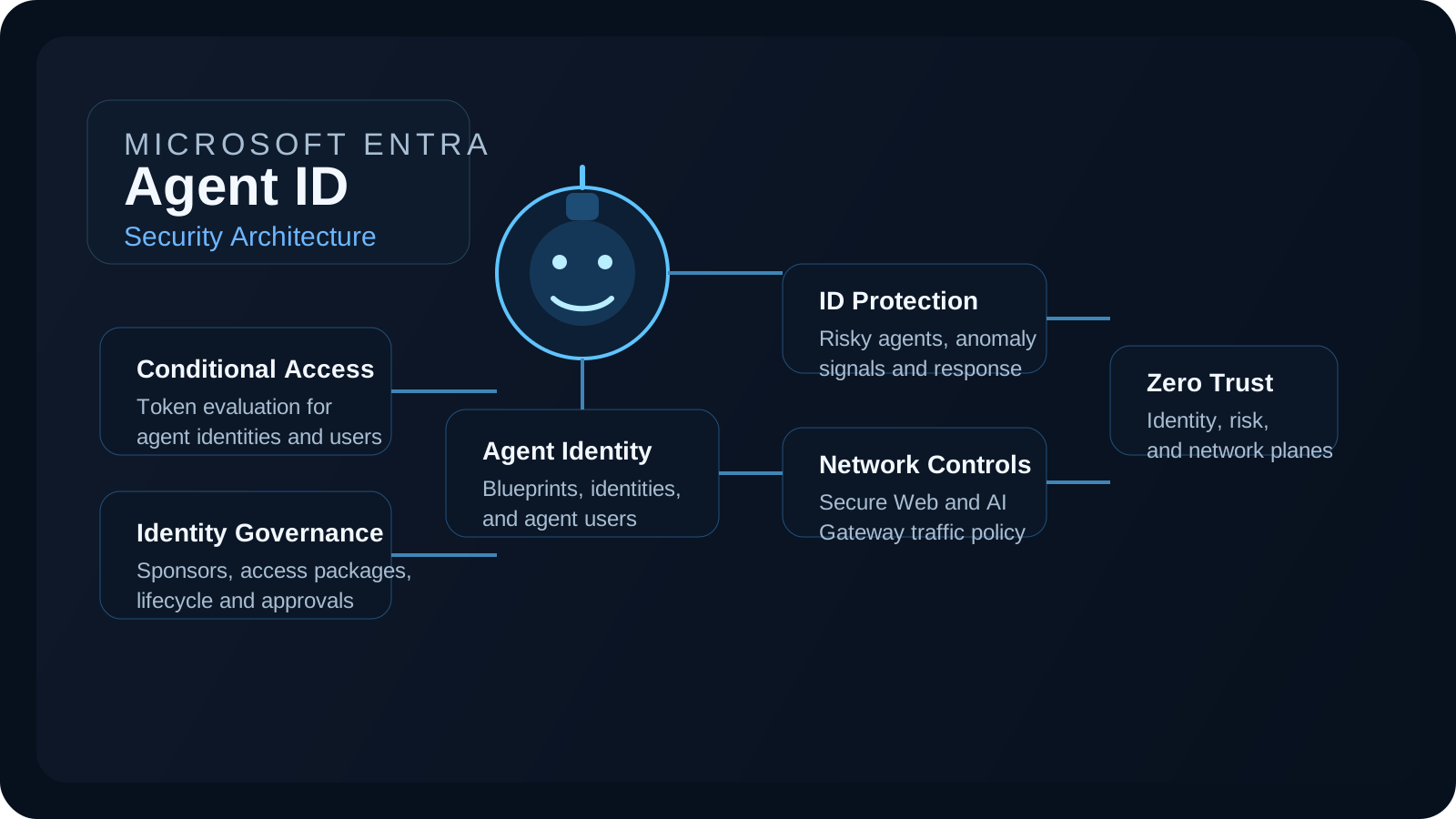
If you are designing around Agent ID today, the cleanest model is to treat it as five connected control planes rather than one feature.
The first plane is identity instantiation. Use the blueprint and instantiated identity model to avoid flattening every agent into a generic service principal.
The second plane is runtime access policy. Use Conditional Access for agent identities and agent users at token acquisition time, and keep in mind Microsoft's documented exclusions for blueprint creation and intermediate token exchange.
The third plane is governed privilege. Use access packages, expirations, approvals, and sponsor-backed accountability instead of permanent role and API permission grants wherever possible.
The fourth plane is risk response. Feed risky-agent detections into Conditional Access so compromised or abnormal agent behavior can be blocked in the token path.
The fifth plane is network egress control. Where the platform supports it, route agent traffic through Global Secure Access so the agent's outbound activity is filtered and inspected instead of implicitly trusted.
That five-plane model is the most natural way to map the current Microsoft documentation into an enterprise architecture pattern.
Design cautions
The current documentation also implies a few cautions that identity teams should take seriously.
First, this is still a preview feature set, so the control surface is evolving. Second, some of the docs are currently tied to Microsoft 365 Copilot / Frontier prerequisites, which means not every tenant can standardize on Agent ID immediately. Third, the object model introduces new identity classes and accountability workflows, so ownership and operations need to be defined clearly before broad rollout. And finally, the model is powerful enough that agent identities should not be allowed to accumulate standing privilege simply because they are "nonhuman."
Agent IDs should be treated with at least the same rigor as privileged workload identities, and in many cases with more rigor because their behavior can be autonomous and adaptive.
Key implementation points
- Microsoft Entra Agent ID is trying to solve governance and security for agent identities as first-class identities, not just as repackaged service principals.
- Conditional Access for agents applies to runtime token acquisition by agent identities and agent users, not to every provisioning step in the blueprint chain.
- Identity Governance for agents is centered on sponsors, access packages, expirations, and accountable lifecycle control.
- ID Protection for agents provides anomaly-based risk signals that can feed directly into risk-based Conditional Access.
- Global Secure Access extends the model from identity control into filtered and inspectable agent network traffic.
Common questions
Is an Agent ID the same as a service principal?
No, but they're related. A traditional service principal represents an app's identity in a tenant for delegated and application-only OAuth flows. An Agent ID represents an autonomous agent (often AI-driven) that may act on behalf of users and may invoke other agents. The object model exposes additional governance hooks (sponsors, lifecycle, conditional access scoping) that don't exist for plain service principals.
What if the Agent ID object model changes before GA?
This is a real risk. Agent ID is preview-state at the time of writing; Microsoft has historically refactored object models during preview-to-GA transitions. The safe operational pattern is to (a) avoid baking Agent ID-specific automation into production change-management workflows until GA, (b) keep agent inventories in a normalized internal store so a Microsoft-side refactor doesn't break your reporting, and (c) subscribe to the Microsoft Entra release notes feed so renames don't surprise you.
Can a Conditional Access policy that targets agents accidentally block human users?
Yes — if the policy's target conditions match both agent identities and user identities in some flows. Always scope agent-specific policies to the agent identity types explicitly (and exclude user from the target where the policy is agent-only). The Conditional Access troubleshooting post covers the diagnostic for unexpected policy hits.
How does ID Protection compute risk for an agent that has no human sign-in?
Risk signals for agents come from behavioral baselines: API call patterns, geographic distribution of requests, time-of-day patterns, and known-bad combinations. A first-week agent has a thin baseline and may produce false-positive risk classifications. Allow time for the baseline to mature before tying agent risk to enforcement.
Where do agent token requests appear in audit and sign-in logs?
In SigninLogs under non-interactive sign-ins, and in MicrosoftGraphActivityLogs when the agent calls Graph. The appId and servicePrincipalId fields identify the agent. Agent sign-in volume is typically much higher than human volume, so set up scoped queries rather than ad-hoc filters.
Is there an equivalent of "revoke sessions" for an agent?
Rotating the agent's credentials (secret or certificate) and removing its role assignments together effectively revokes active access. The token lifetimes and CAE post covers how revocation propagates; CAE for workload identities is not at parity with user CAE today, so plan for a longer effective revocation window.
References
- Microsoft Entra Agent ID for identity professionals
- Security for AI agents with Microsoft Entra Agent ID
- What is Microsoft Entra Agent ID?
- Conditional Access for Agent ID
- Governing Agent Identities
- ID Protection for agents
- Secure Web and AI Gateway for Microsoft Copilot Studio agents
- John Savill video reference
About the author
MU.AMicrosoft 365 / Entra Engineer
MU.A is the editorial byline for Sentinel Identity, covering Microsoft Entra, Microsoft 365, and identity administration. Send corrections or questions through the contact page.
Feedback
Was this article helpful?
Anonymous — no account or comment required.
Related reading
Windows Hello Registration Blocked by Conditional Access
Fix Windows Hello registration blocked by Conditional Access: trace the policy, break bootstrap loops, validate TAP, and restore provisioning safely.
AADSTS50076 MFA Required: Microsoft Entra Fix Guide
Fix AADSTS50076 MFA required errors by tracing Conditional Access, per-user MFA, session changes, app interaction, registered methods, and sign-in evidence.
Disable a Microsoft Entra Agent ID Blueprint Safely
Disable a Microsoft Entra Agent ID blueprint safely, contain its agent identities, preserve evidence, account for live tokens, and restore access cleanly.